Rotate image (square matrix) by 90 deg
Tue, 06 May 2025

Given a sorted array of integers, find a “popular” element i.e. one which occurs more than n/4 times.
If no such element exist (which occurs more than n/4 times) then print error.
For example: If Input array has 8 elements as below
    {1, 3, 3, 3, 4, 6, 9, 10}
Then 3 is the popular element that comes three times.
Solution: Brute Force - O(n)The brute force method will traverse the array linearly and for each element 'i' it will check
if(arr[i] == arr[i+n/4])
   // arr[i] is popular elment
else
   // Continue with other element
It will take O(n) time to find the popular element using above algorithm.
Since the array is sorted, we can take advantage of some binary search type logic to reduce the time taken to lg(n).
lg(n) time algorithm
This is a two part algorithm, first we find the candidate and then we check whether any of the candidate is a popular element.
If we divide the array in 4 parts, then popular element will be first element of one of the four parts.
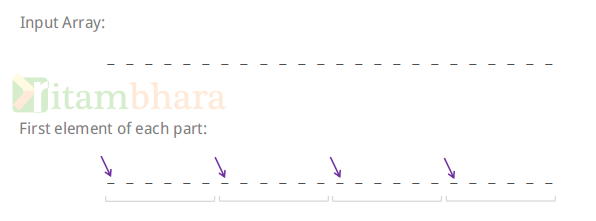
So, no matter how big the array is, there will always be 4 candidates for popular elements. Now, given these 4 candidates, we need to check if any one of them is popular element. To check this, for each of the 4 candidates:
The time taken by this approach is sum of below three number
/* Given Sorted array of size n, this function will return first occurance
 * of element 'd' in array.
 */
int bSearch(int* arr, int n, int d)
{
   int l = 0; int h = n-1;
   while(l<h)
   {
      int m = (l+h)/2;
      // First 2 cases are normal case.
      // 3rd & 4th case means that (arr[m] == d)
      // 3rd case is when we have reached the 1st occurrence of d
      // 4th case is when arr[i] is not the first occurrence,
      // In this case we will have to check the left side of m.
      if(arr[m] < d)
         l = m+1;
      else if(arr[m] > d)
         h = m-1;
      else if(m == 0 || arr[m-1] < d)
         return m;
      else
         h = m-1;
   }
   return -1;
}
Tue, 06 May 2025
Tue, 06 May 2025
Tue, 06 May 2025

Prepare to ace your coding and system design interviews with our comprehensive resources and expert guidance! Ritambhara Technologies offers a curated collection of coding challenges, system design tutorials, mock interviews, and behavioral tips to help you stand out. Whether you're targeting FAANG companies, startups, or tech giants, we provide tailored strategies and in-depth solutions to boost your confidence and sharpen your skills. Explore, practice, and succeed!
Leave a comment