Rotate image (square matrix) by 90 deg
Tue, 06 May 2025

In a Binary Search Tree, you are given the values of two nodes. Write a code which will return the Lowest Common Ancestor of both the nodes.
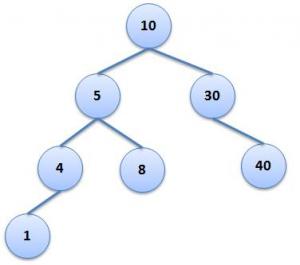
For Example: If the given BST is as shown above and Nodes are 4 and 8,
The output should be: 5
4 and 8 has two common ancestors 5 and 10. But the lowest one is 5.Solution:
Lowest Common Ancestor will be the Node which is ancestor to the nodes and whose value lies between the two nodes.
For any two nodes in a BST, there is one and only one common ancestor whose value will be between the two nodes (i.e less than one and greater than the other).
Algorithm:FUNCTION FindCommonAncestor(Node * root, int a, int b)
IF (value_at_root < a AND value_at_root > b) OR (value_at_root < b AND value_at_root < a)
RETURN root
ELSE
IF (value_at_root < a AND value_at_root < b)
RETURN FindCommonAncestor(root->left_sub_tree, a, b)
ELSE
RETURN FindCommonAncestor(root->right_sub_tree, a, b)
Code:
    /**
     *  Return the Least Common Ancestor (LCA) of Nodes with values a and b
     */
    Node* commonAncestor(Node* root, int a, int b)
    {
        // case when LCA doesn't exist
        if(root == NULL || root->data == a || root->data == b)
            return NULL;
        if( (root->data > a && root->data < b) || (root->data > b && root->data < a) )
            return root;
        // LCA will be on the LEFT sub-tree
        if(root->data > a && root->data > b)
            return commonAncestor(root->lptr, a, b);
        // LCA will be on the RIGHT sub-tree
        if(root->data < a && root->data < b)
            return commonAncestor(root->rptr, a, b);
    }
Tue, 06 May 2025
Tue, 06 May 2025
Tue, 06 May 2025

Prepare to ace your coding and system design interviews with our comprehensive resources and expert guidance! Ritambhara Technologies offers a curated collection of coding challenges, system design tutorials, mock interviews, and behavioral tips to help you stand out. Whether you're targeting FAANG companies, startups, or tech giants, we provide tailored strategies and in-depth solutions to boost your confidence and sharpen your skills. Explore, practice, and succeed!
Leave a comment