Rotate image (square matrix) by 90 deg
Tue, 06 May 2025

Tower of Hanoi is a Mathematical Game. There are 3 pegs (Rods) and number of discs, each of different size, which can be inserted into the rods. All discs are initially inserted into one rod in increasing order (smallest at the top and largest disc at the bottom). You have to move all the discs from source rod to Destination rod, with below 2 restrictions:
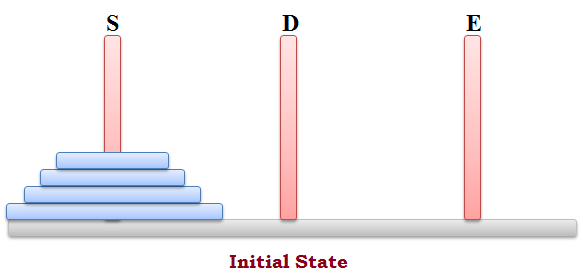
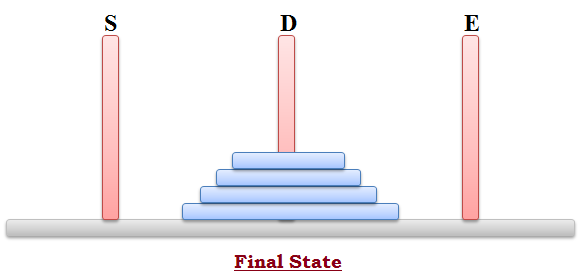
/* The three char represents the characters representing three rods
 * and n is the number of discs (initially in s)
 */
 void towerOfHanoi(char s, char d, char e, int n)
Solution:
The solution to this problem can be easily thought in a recursive approach. The Problem:
Move n Discs from S to D using E
Can be solved in 3 steps:
Step-1:  Move n-1 discs from S to E using D
Step-2:  Move the nth disc from S to E
Step-3:  Move n-1 discs from E to D using S
If you notice, the Step-1 & Step-3 are recursive calls to the same function. Hence the code of the function will be:
     void towerOfHanoi(char s, char d, char e, unsigned int n)
     {
          if(n > 0)
          {
               towerOfHanoi(s, e, d, n-1);
               printf("Move Disk-%d FROM %c TO %c\n", n, s, d);
               towerOfHanoi(e, d, s, n-1);
          }
     }
If we run this Call this function for 3 discs (n=3) like below
towerOfHanoi('s', 'd', 'e',3);
Then the output will be
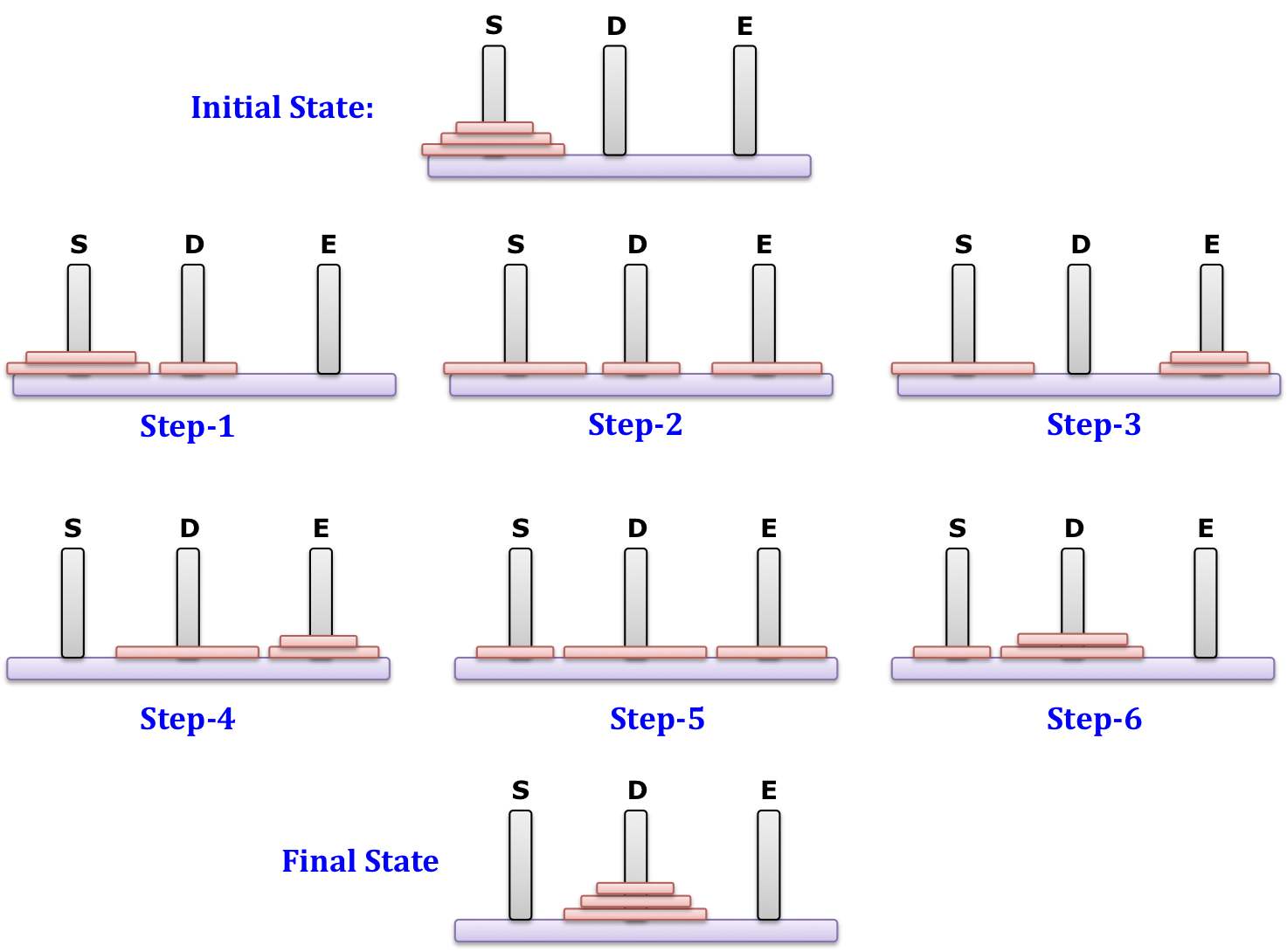
Move Disk-1 FROM s TO d
Move Disk-2 FROM s TO e
Move Disk-1 FROM d TO e
Move Disk-3 FROM s TO d
Move Disk-1 FROM e TO s
Move Disk-2 FROM e TO d
Move Disk-1 FROM s TO d
The actual movement of the disks will be as shown below:
Tue, 06 May 2025
Tue, 06 May 2025
Tue, 06 May 2025

Prepare to ace your coding and system design interviews with our comprehensive resources and expert guidance! Ritambhara Technologies offers a curated collection of coding challenges, system design tutorials, mock interviews, and behavioral tips to help you stand out. Whether you're targeting FAANG companies, startups, or tech giants, we provide tailored strategies and in-depth solutions to boost your confidence and sharpen your skills. Explore, practice, and succeed!
Leave a comment